Monday, February 17, 2020

Alan and Sheila Reeves’ Tanzanian Safari

Submitted by Sheila Reeves


Hot and tired from fending off a dozen hyenas and half that many jackals from its buffalo kill, the big male lion plopped down in the shade created by our safari vehicle. Flies crawled over his face, congregating especially in the corner of his eyes and nostrils. His heaving body was about 10 inches below the open window. There was a temptation to reach out and pet him.


This is Tanzania!

After 23 hours of travel, we set out on an awesome adventure with Steve Gettle Photography and Mazingira Safari Tours! (The day before the trip, Steve Gettle’s father died. He and Nicole Suddeth joined us for the last 4 days of the safari.)


There were eight photographers in three vehicles. In addition to the windows, the entire top of the safari vehicles lifted up about 2.5 feet, so that cameras could shoot above the vegetation.


After several hours of sleep at Rivertrees Lodge, we had breakfast and departed for Tarangire National Park. Tarangire is known for its large herds of elephants as well as the variety of plains animals and birds. It did not disappoint! On the first game drive we saw elephants, giraffes, a leopard, a dik-dik, impalas, jackals, baboons, mongooses, monkeys and warthogs, as well as lilac-breasted rollers, red-billed hornbills, yellow-billed hornbills, magpie shrikes, fish eagles, Egyptian geese, Orange Bishops, Superb Starlings and more! 


We spent most of two days in the field before checking in at the Tarangire Sopa Lodge (elevation:5000 feet). We caught our first glimpse of Hippos, as well as impalas, waterbucks and Thompson’s Gazelles (Tommies).

Then, we headed out for another morning game drive in Tarangire National Park before driving along the wonderful scenic route to Ngorongoro Crater. It was a very muddy, rainy, scary drive!

We arrived at Ngorongoro Sopa Lodge (elevation: 7000 ft), our home for the next three nights. The next morning, we descended 2000 feet into the crater for an all-day game drive. We saw a wide variety of wildlife that call the crater home: lions, zebras, elephants, gazelles, wildebeests, warthogs, hyenas, cape buffalo, jackals, and an abundance of bird species. The crater is actually a caldera formed when the volcano collapsed.


Then, we headed for the Serengeti, enjoying a game drive along the way to the Ndutu Safari Lodge (elevation: 5300 ft). We would call this lodge home for four nights.


In the Serengeti, we were able to go off road! We left before sunrise on Friday, January 31st and enjoyed a safari breakfast in the bush. We spent three long days exploring this area. One of the highlights was having a meal in the field surrounded by thousands of wildebeests and zebras. The animals did not come close when we were out of the vehicles, but every direction we looked, they lined the horizon. Another highlight was coming upon a newborn wildebeest. Our drivers/guides told us it was probably just an hour or two old. When we first stopped to observe, the baby was standing on wobbly legs, but in a few minutes, it was walking, and a few minutes later, it was running. The babies need to be able to keep up with the herd within hours of birth.


We left Ndutu, and enjoyed another game drive as we travelled to the Ngorongoro Farm House, where we arrived for lunch. It was pouring down rain when we arrived. January and February are supposed to be the dry season in this part of Tanzania. But this year, it had rained at least a little EVERY day since October. There has not been a dry season. The only day of our trip with no rain was the day we left.


On our last day in Africa, we packed up for our return home. We drove to Arusha where we had a leisurely lunch at Jacob’s home, prepared by his wife. After lunch, we spent a few hours at the Cultural Heritage Centre in Arusha before heading to the airport for a very long journey home!

The lodges were all very nice. We had plenty of food. The driver/guides were competent and extremely knowledgeable. We felt well cared-for. We saw some amazing sights and took some really fun photographs. It was a grand adventure!

And if electricity, hot water, and Wi-Fi were in limited supply? Well, that is Africa!

Sunday, February 16, 2020

Nature Group Travels to Reelfoot Lake

Submitted by Julie Barrick

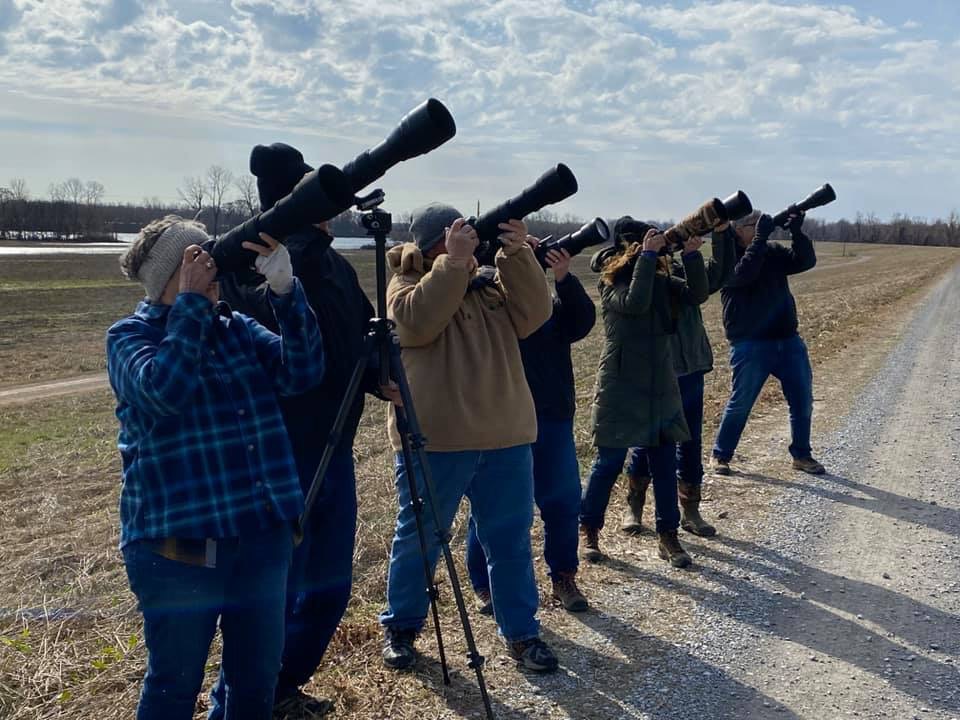
The Nature Group had a great adventure last weekend, February 7 - 8, at Reelfoot Lake in Tennessee. Twelve people went, nine Sunny Sixteen members and three spouses.


We were so fortunate to have a local photographer show us around the area. As soon as we arrived at Reelfoot on Saturday, we met up with Jere Hughes and his adorable dog, Harlie. We consolidated cars and headed out looking for eagles. Jere took us to several places in the area where we saw several eagles, geese, ducks, and deer. Jere was a great man full of knowledge for potential animal sightings both now and other seasons of the year.


One of the most fun things we did and most successful was riding the levees along the Mississippi River. There are several eagle nests along the levees including one that you can approach very close. On Sunday both eagle parents were at this nest. One in the nest and the other right above it. We enjoyed hearing them talking back and forth to each other.


We stayed at the Blue Bank Resort, and all twelve of us had dinner together there that evening. The food was yummy!


The Next morning we headed out early looking for more eagles. Some went their own direction and some ventured out together. We were treated to some really good eagle sightings that day and thousands upon thousands of Snow Geese and Greater White-Fronted Geese. Seeing all the geese virtually take off at once is a sight to behold.


I think everyone had a great time! Thanks to all who went!


******We are in the early stages of planning a very exciting trip for March 2021. We are going to Kearney, Nebraska to see          "The Great Migration" of Sandhill Cranes. Stay tuned for more details!******


Saturday, February 15, 2020

How Was it Done - Turning Day into Night - A Closer Look

Submitted by Keith Bridgman


Photographing backyard birds from a bird hideaway is often a great deal of fun and filled with anticipation. It is a type of photography that almost anyone can do using a few basic principles and a little patience. Using a simple blind setup allows a photographer to get within a few yards of most backyard birds and by applying a little bit of ingenuity, you can attract a great many types of birds thru all seasons of the year.


One thing that becomes noticeable over time is more often than not, you end up capturing the same kinds of birds the same ole way...over and over. After a while your photo's begin to all look alike. It can become a bit repetitious. To avoid experiencing birding burnout, try shaking things up from time to time.

Simply rearranging your feeding area where the birds are attracted can create a new look. But, even this has its limitations. So why not try something out of the ordinary...like...turning day into night and photographing your backyard birds in what appears to be a night time situation.

Turning day into night...uh, well yeah, it can be done...with a little understanding of photographic principles. Simply stated...you do it by using Speed Lights.

Let's take a look at the attached photo of a Red-Bellied Woodpecker at the top of this post. At first glance it appears to have been taken at night, but, in reality, it was taken in broad daylight in the middle of the afternoon.

The idea is actually quite simple, but you gotta set your camera on Manual. Oh my gosh...the dreaded Manual Mode...I could never do that. Well...trust me...yes you can. Here is how it works.

Set your camera on a tripod locking securely. Set your camera to Manual. Set your ISO to the lowest value your camera will allow...probably 100 or maybe 200 depending on the camera. Manually select the fastest flash Sync shutter speed...most cameras are 1/200 or 1/250 of a second. Some allow for what is known as High Speed Sync...but we won't go into that because it is not necessary to accomplish what we want to do. You will also want to use a long telephoto lens, something in the neighborhood of 300mm works fine, but, if you have one, a 400, 500, or even 600mm lens works even better. Your camera and tripod should be set up so you are looking at the bird from eye level and placed about 5 yards or so away. This requires some forethought in setting up your feeder/attractor arrangement.

In just a moment we will set the Aperture, but let's do this first. When you are photographing backyard birds from a blind, usually you will obtain better results if there is a solid background several yards behind where the birds will be perching. Most of the time something that is a neutral color like a green hedge or a group of trees or something along that nature works pretty well. This provides for a soft and unobtrusive background which allows for the birds to be separated from any kind of distracting clutter. Take a look at the photo below taken on a cloudy day and you will see what I mean.


Okay...now here is where we explore an element of photography that a lot of photographers tend to shy away from: using an external flash unit. We're not going to go into the fine details of this interesting element of photography..we're just going to explain how to employ a flash to turn day into night.

After having made the preliminary setup, the next step is to eliminate as much of the ambient background light as you can. Even on a sunny day, you can do this by simply cranking up the aperture (in manual mode) to something like f/22 (a very small opening) or higher. When used in conjunction with the highest flash sync speed of the camera and a low ISO (never use AUTO ISO trying to do this), the background will simply go dark as a result. In fact, your whole image will go dark...and this is exactly what we want to do.

One more thing, you will probably want to use manual focus as well. Just simply pre-focus on where the birds will perch and by using an aperture of f/22 you will not have any issues with Depth of Field as the birds will be in focus. Auto focus can be used, but the birds drop in and out so quickly, it is sometimes difficult to get the camera to focus before the birds are gone.

So, at this point you should have your camera and telephoto lens set on a tripod. Your camera should be set on manual mode with the shutter speed set to 1/200 of a second and your aperture set to f/22 or higher. Any photos you take should be just about completely dark.

If so, now we need to add in some light...that is where an external speed light comes into play. It matters very little what brand, as long as the flash unit can be fired remotely from the camera. I use Godox flashes using a separate Godox transmitter attached to the camera's flash hot shoe.

You can do this with a single flash, but two are better where three might add in some extra lighting depth. I used two...look at the setup photo below.


One flash set to either side and slightly behind of where the birds will perch/feed. Both are about 2 feet from the perch and angled down to illuminate the feeding location. The power settings on the flash units will vary, but in this particular instance both were set to 1/2 power and zoomed to around 50mm (most flashes allow for a focused flash adjustment from 24mm to 105mm).

Now it was just a matter of waiting for one of the birds to show up...and it didn't take long. I only placed food for the birds on one location...the stump you see in the setup image. This was to insure any birds would all come to the same place plus i had been feeding them for a few weeks prior to this so they were accustomed to having food provided for them.

The introduction of the flashes on their stand did not appear to cause any problems and the flashes themselves did not seem to bother the birds.

So there you have it...it took a while to get there, but that's how you turn day into night and allow for some interesting backyard birding photo ops.


Thursday, January 9, 2020

Incredible Adventure

Posted by Keith Bridgman

One of the most important elements of a successful photographic day afield is to simply be there. This holds true for every form of photography, however, when it comes to wildlife photography, being there is a mandatory prerequisite.


The Sunny Sixteen Nature Group is perhaps the most successful and well attended groups within the club. Julie and Mary Beth do a wonderful job organizing the various outings. Most are local, but a few take the members out of state. One of the best out of state locations is near Seymour, Indiana where upwards to 30,000 Sandhill Cranes spend the winter on their migration. They tend to use an area known as the Ewing Flats, just west of Seymour. This area is a flat expanse of farm country which apparently provides an appealing stop over for the migrating Sandhills.


The first Nature Group outing to Ewing Flats for the new year 2020 was scheduled for January 9th...and I was finally planning on attending this one. As luck would have it, circumstances arose that interfered with my being able to make it on that day, but, I would be able to go up a day or so earlier to check it out.


July 7th was my projected attempt and indeed I crawled out of bed at 4 AM to head out by 4:30. I wanted to get there early, around sunup, to take advantage of the morning light. About 90 miles up the road, my alternator started acting up and to spare you the heart rendering details, I managed to limp home by nursing the old Jeep back without destroying my battery or something else more mechanically critical. Spent the afternoon replacing the alternator...and, got up at 3:30 the next morning to give it another try.


Right at sunup, I was standing along the country road in Ewing Flats waiting for the Sandhills to begin stirring...and stir they did. The first light of the day proved the worth and effort of the early rise and drive as the sky was mostly clear, cold for sure, but free of troublesome clouds that often interferes with certain types of photography. What I did not yet know was this was just the warm up for the grand show that would come later in the day.


As the Sandhills began to stir and fill the morning sky with their graceful flight and chattel-like calls, I found myself snapping photos rapid fire...not paying attention to any of the photographic principles I so often try to emulate. The first one hundred or so shots where characterized as cliched snap shots of the Sandhill's flying, and standing in the fields, of which I already had hundreds if not thousands from previous attempts. I knew I wanted more...something to stand apart from what almost anyone can take. I needed quality, not quantity and so I began to evaluate what was happening and to formulate a plan on how to go about photographing these amazing birds that not only captured their unique blend of migratory endurance, but the flavor of their world and environment.


First off I looked for opportunities to get close to the birds...not an easy feat as they tend to be tolerant-shy of people, but they do not seem to be concerned with vehicles. My Jeep would make an excellent blind from which to shoot, and I knew from past experience with these birds, some will often land very close to the edge of the roads. It didn't take long to locate a small group loitering about 10 yards off the road. That is when I made my first mistake. I stopped, grabbed my camera, opened the door, and stepped out right in front of the birds. Within two seconds they were gone. Next time, I would park so the drivers-side door would open away from the birds and I would exit more quietly and shoot from behind the Jeep.


The main reason I wanted to step out of the Jeep instead of shooting from inside was I wanted to get low and look them in the eye instead of looking down on them. The idea is to immerse yourself into their world from their perspective. It took some practice but through the course of the day I managed to do just that; use the Jeep to block them from seeing me, and shoot from a sitting position.

I also wanted to find situations where the birds would be back-lit by the sun. This kind of light provides an excellent shape-defining glow around their frame and also serves to generate some very unique and interesting background light. The light begins to shine and reflect not just off them but through them.


By mid-afternoon I had already taken a good number of photos, including a Whooping Crane sighting, but I began to think about what the birds would do once the day approached sundown. They tend to feed all day in the fields, then go to water and then to roost. The trick was to figure out in what direction they would fly at sundown, then position myself in a location so as to isolate them against the setting sun. All I could do was guess and hope they would cooperate.


About an hour before sunset, they began to stir. I was positioned between where a large number of them were feeding in a field and the sun would set pretty much behind them. The idea was, regardless of what direction they would fly, at least some of them would be silhouetted against the sunset for a short time. Hopefully, I would be able to catch a few good photos with the sunset as the backdrop.


The camera you use is an amazing tool equipped with a wide variety of creative functions that can be used to accomplish what you the artist wants to create. I wanted rich, vivid colors, so I manually pushed the White Balance up to around the 9000-k degree light temperature setting which would create a much richer, warm-enhanced light. With any kind of luck, this would generate the combination of natural vs creative balance I needed.


The problem was, the birds began to leave too soon. The sun was a full hour from setting, and all the birds feeding in the fields began to rise up in mass and exit to the east, away from the where the sun was to set. Regardless, I did what I could shooting the flights as they passed overhead or nearby. Before long, most of the birds had left with just a few stragglers milling around. I debated about going ahead and leaving, but something in the back of my mind said..."Not just yet...stick around and see what happens."


I'm glad I listened. About 10 minutes or so before the sun was to set, I heard a huge flight of birds returning from the east heading straight into the sunset. Over the next half hour, thousands, and thousands of Sandhills flew overhead in wave after wave. I almost wore out my camera shooting rapid fire 10 frames a second as they drifted to and fro across the magnificent light that was forming across the horizon. I shot and shot until it go so dark, I could no longer shoot and when the spectacle was finally over, I knew the day had been a day I would never forget.


The few photo's I share here only touch the surface of what I experienced that day. I also took quite a few segments of video footage a stream of which you can watch at the bottom of this post.


Incredible adventure to say the least, an amazing red-letter day that will forever go down as one of the highlights of my photographic endeavor.